
When Millimetres Matter. How SITECH Solutions Brought Precision Technology to the Outback for Airport Consultancy Group
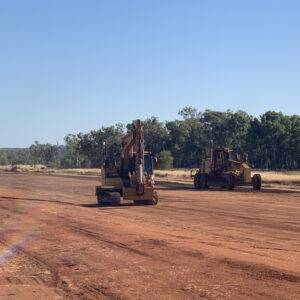
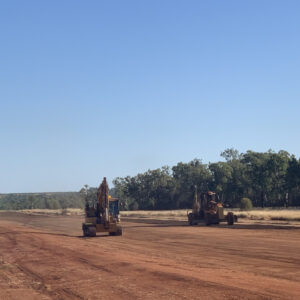
In the sprawling cattle country of regional Australia, where the nearest parts supplier can be a two-hour drive away and the nearest city considerably further, a Caterpillar 315 excavator is breaking new ground. Literally.
On a vast organic beef station spanning roughly 250,000 hectares, Airport Consultancy Group is building a private airstrip to a standard that would satisfy the most exacting civil aviation engineer. And the technology making it possible arrived in the cab of a ute driven by SITECH Solutions support technician Matt Leonard, who had clocked close to a thousand kilometres before the working week had properly begun.
The project centres on Trimble Earthworks, a grade control platform that transforms heavy machinery into instruments of surgical precision. On this particular airstrip, precision is not merely desirable, it’s financially critical.
As Craig Halliday, Director of Airport Consultancy Group, puts it plainly to Matt: "We're chasing millimetres."
Where roads and ports require a more lenient tolerance of between 10 and 15 millimetres for pavement levels, Halliday's specification is +0/-5mm. The reason is straightforward. The design specification requires a tight tolerance to ensure optimal ride performance for aircraft.
It is the kind of tolerance that separates conventional earthmoving from precision construction, and it is exactly the scenario where Trimble's Universal Total Station (UTS) system earns its place on the machine. Unlike standard GPS or GNSS-based grade control, which can be affected by atmospheric interference and satellite geometry, a UTS uses a ground-based total station to track a prism mounted on the excavator, delivering sub-three-millimetre accuracy in real time. A UTS provides accuracies of less than 3mm, and Trimble Earthworks works seamlessly with both GNSS and UTS configurations, offering flexibility and versatility depending on the demands of the project.
For final trim work on an airstrip surface destined for sealing, it is the only viable option.
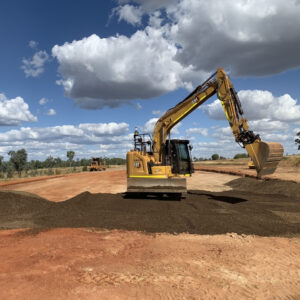
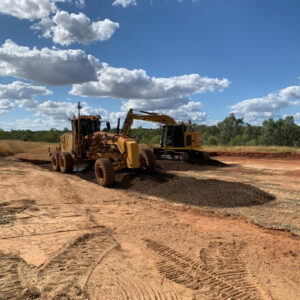
The relationship between Airport Consultancy Group and SITECH Solutions began five years ago in Port Macquarie, when Matt fitted out a Caterpillar 150 motor grader with Trimble Earthworks on a full UTS setup. That grader is still running the same configuration today.
As the company's work expands, Halliday does not look for another supplier. He asks for Matt.
Airport Consultancy Group is not a small regional contractor. ACG operates across Australia, the Asia-Pacific region and internationally, with a team that includes PhD-qualified pavement engineers, senior electrical engineers specialising in airport lighting, and airside safety officers.
The company holds ISO 9001 quality accreditation and ISO 45001 health and safety certification, and has delivered projects for Defence, civilian aviation and mining-sector aerodromes. Craig Halliday himself has more than twenty years of airfield pavement construction experience, including managing projects at Sydney Airport and overseeing the RAAF Base Williamtown Ordnance Loading Aprons project.
That a client of this profile has chosen to anchor its relationship not just with a technology brand but with a specific technician says something worth noting. It speaks to the kind of trust that does not transfer easily and cannot be replaced by a competitor's product brochure.
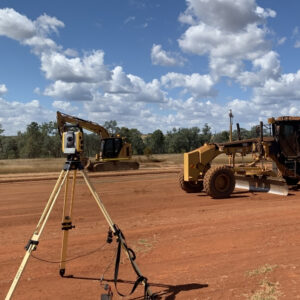
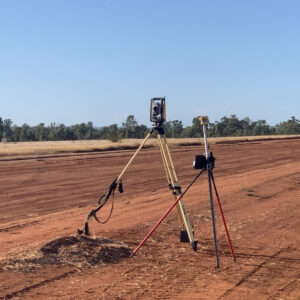
Monday was spent twelve hours behind the wheel, driving. Tuesday was twelve hours on site, with the excavator positioned just twenty metres from his accommodation. A parts run to Emerald, two hours each way, completed the install. By Wednesday, Matt was on site training the machine operator on the newly commissioned system, and also revisiting the grader to ensure everything remained calibrated and up to date. By Thursday morning, he was planning a 3am departure to make it home by Friday.
This is the reality of field support in construction technology, and it is one the industry rarely documents.
The technology itself attracts attention. The person who drives it to site, installs it in the heat or the freezing cold, sources the missing component from a regional town, and then patiently walks an operator through every function before leaving, tends not to.
Matt is in his thirteenth year with SITECH. He is still learning, he says, and is clear-eyed about what that means for the profession: "Anyone that sits there and says 'I know everything' is wrong."
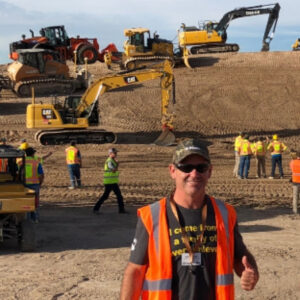
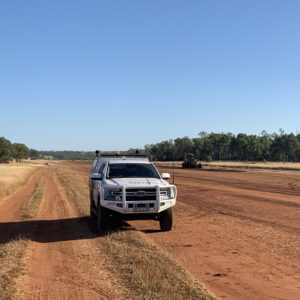
The depth of knowledge required to do this work well is not something that can be shortcut. Matt estimates it takes two solid years before a new technician is capable of operating independently across the range of situations the role presents.
The skills are teachable, he maintains, but the timeline is not compressible.
The airstrip is taking shape, measured to +0/-3mm across 1.2 kilometres of Class 2.1 crushed on-site pavement material.
When the surface is sealed and aircraft begin landing safely, passengers most probably won’t think about the thousand-kilometre drive, the 3am departure, or the parts run through the outback. They rarely do.
But the runway will be there, true to +0/-3mm, because Matt Leonard and the teams at SITECH Solutions and Airport Consultancy Group made sure of it.

*As published in Earthmoving Equipment Magazine.
Learn more about how Trimble construction technology can work for your business, contact us here or call us on 02 6788 2155.